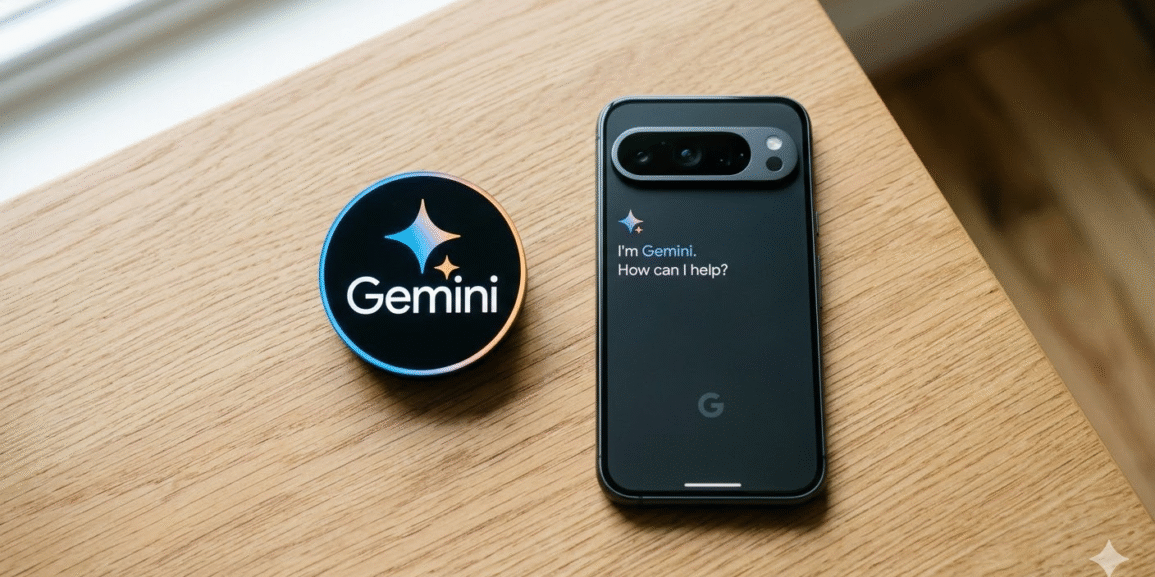
For years, the promise of the “AI smartphone” has largely been limited to reactive interactions you ask a question, and a chatbot provides an answer. However, this past week, Google signaled a seismic shift in that paradigm. By announcing a deeper, system-level integration of Gemini AI for task automation, Google is moving away from the era of the digital assistant and ushering in the age of the autonomous mobile agent.
The Backbone of the Next Generation
This new iteration of Gemini isn’t just an app running on top of an operating system; it is becoming the nervous system of the upcoming Pixel 10 and the Samsung Galaxy S26. Powered by the next-generation Tensor G5 chip Google’s first fully custom designed silicon the Pixel 10 is being built from the substrate up to handle “cross-app orchestration.”
Unlike current AI, which often hits a wall when moving between different software silos, this autonomous system is designed to execute complex workflows. Imagine telling your phone, “Book a table for four at a highly-rated Italian spot near the theater for Friday, then invite the group via WhatsApp and add it to my calendar.” In the past, this required manual navigation through three or four different apps. With the new Gemini integration, the AI acts as a connective tissue, navigating the UI of third-party apps to complete the task on your behalf.
From Chatbot to Autonomy
The core distinction here is agency. While earlier versions of Gemini focused on generative text and image editing, the 2026 update focuses on Action Models. These models understand the intent behind a command and can map out the necessary clicks, swipes, and data entries required to achieve a goal.
For the Pixel 10, this means a “Zero-Touch” philosophy. Whether it’s filing an expense report by pulling data from Gmail into a spreadsheet or organizing a multi-city travel itinerary, the hardware and software are now synchronized to treat the smartphone as a proactive tool rather than a passive screen.
A Unified Android Future
By extending this backbone to the Samsung Galaxy S26, Google is ensuring that this autonomous standard becomes the benchmark for the Android ecosystem. This partnership suggests a unified front against competitors, positioning Android as the premier platform for users who want their devices to not just “know” things, but to “do” things. As we approach the late 2026 launch window, the Pixel 10 stands as the flagship for a future where your phone finally works as hard as you do.



Leave a Reply