
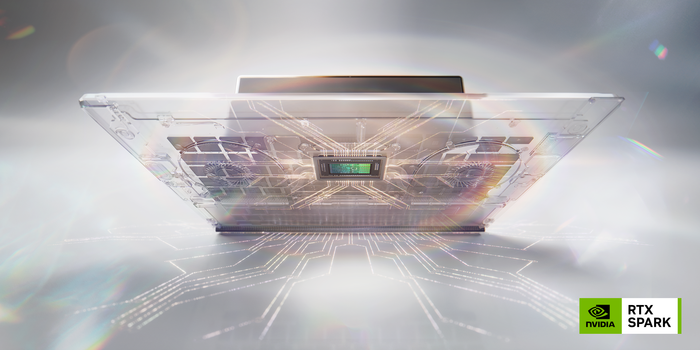
At Computex 2026, NVIDIA CEO Jensen Huang took the stage to announce a paradigm shift in personal computing. After years of dominating the graphics and data center markets, NVIDIA officially introduced the RTX Spark, an Arm-based “superchip” built in collaboration with MediaTek. Designed to challenge the x86 dominance of Intel and AMD, the Spark positions itself as the foundation for a new class of Windows machines, the personal AI computer.
Datacenter Muscle in a Laptop Form Factor
The RTX Spark is not a traditional standalone processor. Manufactured on TSMC’s cutting edge 3nm process, it fuses two heavy-hitting architectures via a high bandwidth NVLink interconnect:
- The CPU: A highly power-efficient, 20-core NVIDIA Grace processor.
- The GPU: A powerhouse based on NVIDIA’s latest Blackwell architecture, boasting 6,144 CUDA cores delivering graphical performance comparable to a dedicated desktop RTX 5070.
The crown jewel of this architecture is its support for up to 128GB of LPDDR5X unified memory. By allowing the CPU and GPU to pull from the exact same ultra-fast pool of RAM, the chip bypasses traditional system bottlenecks.
Moving from “Tool to Teammate”
NVIDIA’s vision for the RTX Spark centers heavily on “agentic AI.” Capable of pushing an astonishing 1 petaflop of local AI performance, the superchip is built to run massive 120-billion-parameter large language models natively on your desk, without relying on the cloud.
For creators and power users, this translates to staggering performance. The chip can render ultra-large 90GB+ 3D scenes, smoothly edit 12K video files, and take full advantage of Adobe software, which is being rearchitected from the ground up for the platform. For gamers, it brings the full suite of RTX technologies including DLSS 4.5 and ray reconstruction to Arm-based Windows devices, promising fluid 1440p gaming at over 100 frames per second.
The New Dawn of Windows on Arm
Major hardware manufacturers, including ASUS and MSI, have already showcased premium, razor-thin laptops powered by the new silicon. Dropping in the fall of 2026, the RTX Spark marks NVIDIA’s true evolution from a components manufacturer to a full-system architect, fundamentally rewriting the rules of what a laptop can do.




Leave a Reply